Guide · Crescent Moon Shibas
Tinsel, Fruitcake, and the Puppy Under the Tree
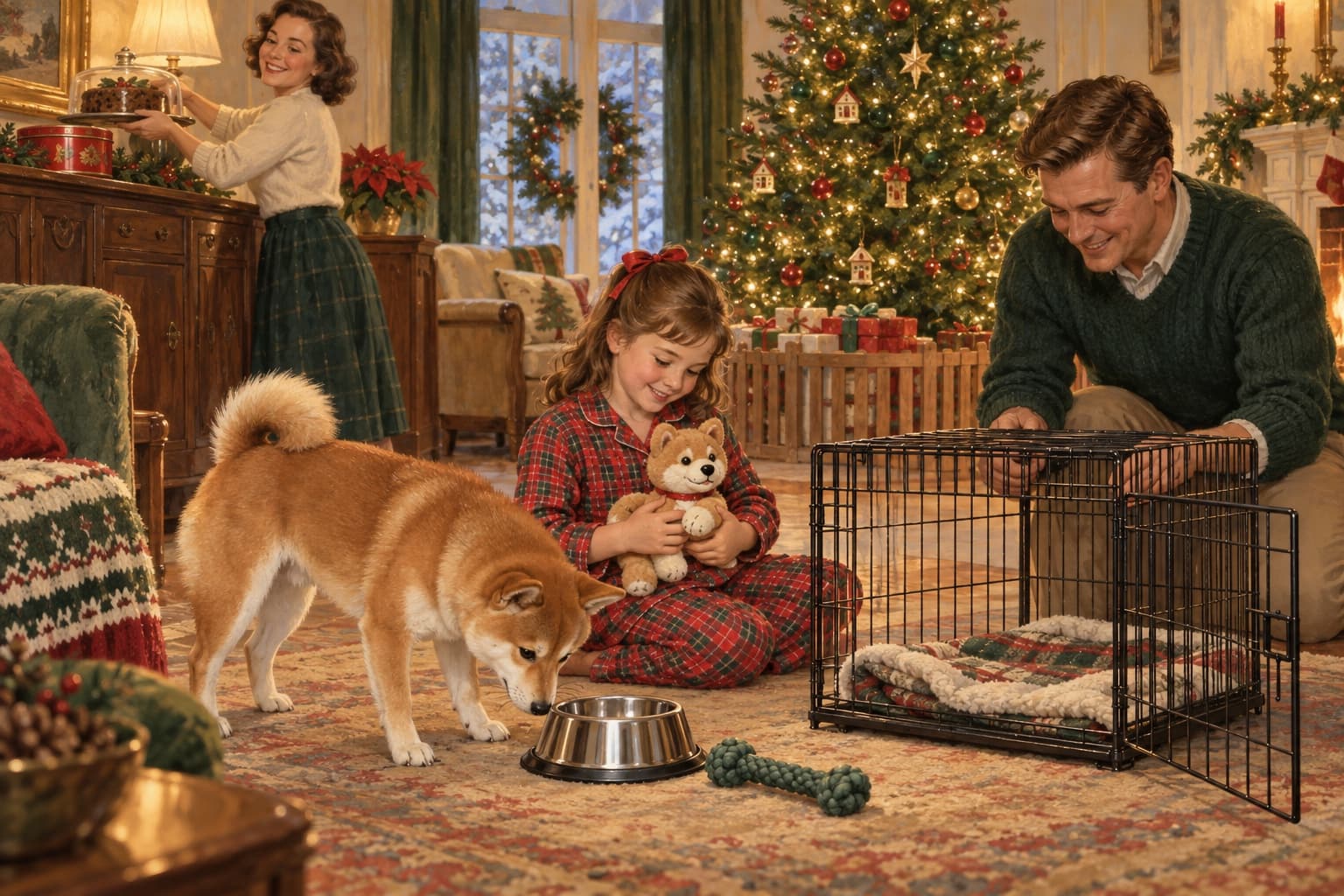
Christmas dos and don'ts for dogs: the tree, the table, the plants, the gifts, and the one week a year when the whole house is full of things a dog should not eat.
Christmas runs for weeks, and the hazards pile up in layers. The tree goes up, then the plants, then the boxes of chocolate, then the guests. Pet Poison Helpline says chocolate has been its most common call for more than a decade, that dogs make up about 95 percent of those calls, and that Christmas is its busiest chocolate holiday, ahead of Halloween.[12] The AVMA's first piece of holiday advice has nothing to do with food: know where the 24-hour emergency clinic is and how to get there before you need it, and keep your vet's number and both poison lines posted where everyone can find them.[1]
The food
Chocolate
It arrives in advent calendars, stockings, tins on the coffee table, and wrapped boxes under the tree. A dog does not need to see the chocolate to find it. The ASPCA's specific advice is to keep wrapped food and candy off the floor and away from the tree.[2]
How much is a problem depends on the type and the dog. Merck's figures: milk chocolate carries about 64 mg of methylxanthines per ounce, dark and semisweet about 150 to 160, baking chocolate about 440, and cocoa powder about 807. Mild signs can start around 20 mg per kilogram of body weight, heart effects at 40 to 50, and seizures at 60 and above.[11] For a 20-pound dog that puts the first signs at roughly 3 ounces of milk chocolate, a little over an ounce of dark, or less than half an ounce of baking chocolate. For a 60-pound dog, about 8 to 9 ounces of milk, 3 to 4 of dark, or a bit over an ounce of baking. Signs usually appear 6 to 12 hours after the dog eats it, and theobromine's half-life in a dog is about 17.5 hours, so a bad case builds overnight.[11] Count the wrappers, note the type, and call with the dog's weight.
Baked goods and sugar-free anything
Cookies, fudge, and quick breads are mostly a fat-and-sugar problem, which is covered below. The exception is anything made with xylitol, which turns up in sugar-free baking, some peanut butters, gum, and mints, sometimes labeled "birch sugar." In a dog it triggers a fast insulin release and a dangerous drop in blood sugar, with signs starting in 10 to 60 minutes and sometimes delayed 12 to 24 hours.[13] Treat any exposure as a call-now event. The AVMA's holiday page singles out xylitol in sweets and baked goods as linked to liver failure and death in dogs.[1]
Fruitcake, eggnog, and the bar
Pet Poison Helpline lists fruitcake as a holiday myth that turns out to be true: it can be deadly, because the raisins, currants, and grapes in it can cause kidney failure in dogs, and the rum-soaked versions add alcohol on top.[4] Merck's working estimate is that more than one grape or raisin per 10 pounds of body weight may be enough to injure the kidneys. Vomiting starts within 6 to 12 hours and kidney failure can follow within one to three days.[14]
Eggnog, spiked or not, is cream, sugar, and raw egg, and the spiked kind adds the one ingredient that works fastest. Alcohol signs in a dog begin within 30 to 60 minutes: vomiting, staggering, disorientation, then in a bad case low body temperature, slow breathing, seizures, and coma. Making the dog vomit only helps in the first 20 to 40 minutes, before signs begin.[15] Glasses left on end tables at a party are at exactly the right height.
Ham, gravy, skin, and the fat
The Christmas plate has the same problem as the Thanksgiving one, with ham added. Fatty table food will not poison a dog, but it can set off pancreatitis, and the vomiting that announces it typically arrives one to four days after the meal.[16] Pancreatitis is a dog that stops eating, vomits, and has a sore belly, and Merck names Miniature Schnauzers, Yorkshire Terriers, Cocker Spaniels, Dachshunds, and Poodles as breeds that get it more often.[17] Ham adds salt to the fat. The AVMA's list of what to keep away from the dog is short and specific: gravy, sauces, dressing, and meat or poultry fat or skin, and bones, which choke or block, and it names onions in the same breath as raisins and grapes.[1] Dressing, gravy, and the casseroles are built on onion and garlic, which damage a dog's red blood cells over several days.[30]
Rising yeast dough is its own emergency. The dough keeps expanding in the stomach and the yeast produces alcohol, so the dog gets a swollen belly and a drunk one at the same time, and in a deep-chested breed the swelling can set off bloat.[18] Macadamia nuts, common in holiday cookies and nut bowls, cause weakness, wobbling, tremors, and a high temperature within about 12 hours, almost never fatal but worth a call.[19]
What is fine
A small piece of plain cooked turkey or lean meat with no skin, no bones, and no seasoning, plain cooked vegetables, a spoonful of plain canned pumpkin, and the dog's own treats. The AVMA's suggestion is the simplest one: if you want the dog to have a holiday treat, make or buy one made for dogs.[1] Keep the dog on the regular diet otherwise. The once-a-year plate of rich food is what sends dogs to the clinic on December 27.
The tree and the decorations
The tree itself. A dog that bumps a tree or pulls on a low branch can bring the whole thing down. The AVMA's suggestion is fishing line from the top of the tree to the ceiling or a door frame.[1, 2]
Tree water. Pet Poison Helpline's staff veterinarian rates plain tree water as a mild problem: vomiting and diarrhea are possible, and even with a preservative added the result is usually mild stomach upset.[5] The AVMA goes further and says not to add anything to the water at all if there are pets in the house.[1] Standing water also grows bacteria, and the ASPCA's advice is to cover it or block access.[2] Needles irritate the mouth and stomach, and a dog that eats a lot of them can end up with an obstruction or a perforation, because needles do not digest well.[5]
Tinsel and ribbon. Tinsel causes no poisoning. A long thin object like tinsel, ribbon, or string can anchor at one end, usually at the base of the tongue or in the stomach, while the gut tries to move the rest along. The intestine bunches up on it like fabric on a drawstring, the string saws through the wall, and Merck notes this kind of obstruction carries a higher risk of perforation than most; the surgeons' college treats it as a case for surgery.[20, 21] If you see string under the tongue or hanging from the mouth, do not pull it. Merck's instruction is that it must be cut at the anchor point, never pulled, and the dog goes to the vet.[20] Treat anything hanging from the other end the same way. Pet Poison Helpline's advice for a cat house is to skip tinsel entirely.[3] For a dog house, keep it and the curling ribbon up high and the gift wrap trash out the door the same night.[1]
Ornaments. Glass breaks and cuts the mouth and gut. Swallowed ornaments block.[1, 2] Salt-dough ornaments are a particular problem because they taste like food and carry enough salt to cause a life-threatening electrolyte imbalance.[1, 2]
Lights and cords. Chewing a live cord burns the mouth and can put fluid in the lungs, and Merck says to call even when the injury looks mild, because complications can develop later.[22] A young dog with burns in the mouth or unexplained labored breathing after being alone with the tree needs the vet now.[22] Run cords behind furniture or through cord covers, and the AVMA's rule for when you leave the house is to unplug the decorations.[1]
Candles and oil lamps. Never leave the dog alone in a room with one lit.[1, 2]
The plants
Most of the Christmas plant worry is pointed at the wrong plant.
- Poinsettia is the famous one and the least dangerous. The ASPCA lists it as toxic to dogs on the strength of its irritant sap, which can cause drooling and vomiting, and notes in the same entry that its toxicity is generally overstated.[6] Pet Poison Helpline calls the deadly-poinsettia story a myth.[4]
- Mistletoe. American mistletoe carries lectins that cause vomiting, diarrhea, trouble breathing, a slow heart rate, and rarely low blood pressure.[7] Pet Poison Helpline's view is that small amounts usually mean mild stomach upset and that the serious cardiovascular effects are rare in pets.[5] The plastic berries on store-bought sprigs are a blockage risk of their own.[5]
- Holly. Saponins in the plant cause vomiting, diarrhea, and a dull dog, and the stiff, spiny leaves can injure the stomach and intestine on the way through.[8, 4]
- Amaryllis. The flowers and leaves cause vomiting and drooling. The bulb is the dangerous part, with lycorine and other alkaloids that in a large dose can bring on weakness, tremors, seizures, and blood pressure changes.[9, 5] Keep the pot where the dog cannot dig.
- Lilies. A cat emergency, where a bite of leaf or a lick of pollen can cause kidney failure. In a dog, lilies usually mean stomach upset.[2, 4] If there is a cat in the house, no lilies in the house.
- Christmas cactus is on the ASPCA's non-toxic list for dogs.[10]
The AVMA's broader list adds balsam, pine, and cedar as plants that can cause trouble when eaten, and sends readers to the ASPCA's plant database.[1]
The rest of the house
Liquid potpourri and simmer pots. These contain essential oils and often cationic detergents, which cause chemical burns to the mouth, skin, and eyes. Cats are the most sensitive, but Pet Poison Helpline notes that a dog that licks a spill can be burned too.[4, 1] Dry potpourri can cause problems if eaten.[1]
Snow globes and antifreeze. Some snow globes are made with ethylene glycol, the chemical in antifreeze, and the spill from a broken one smells sweet and draws a dog.[2] Pet Poison Helpline notes the concentration in a globe is usually low, but the amount a dog got is never known at the time.[3] The undiluted product is a different matter: about 3 to 4 teaspoons of antifreeze is a lethal dose for a dog, signs begin almost immediately, the dog may seem to recover around 12 hours, and kidney failure follows at 36 to 72 hours. The antidote only works if it is given before the kidneys fail.[23] A garage spill or a driveway drip in December is the more common source. Either way, call immediately and clean up thoroughly.
Batteries. Every new toy and remote needs them, and they end up on the floor. A chewed alkaline battery leaks and burns the mouth, and a swallowed button battery burns the esophagus or gut from the inside. Drooling and pawing at the mouth are the early signs, and the mouth ulcers may not show for hours. Do not make the dog vomit. Go to the vet.[24] Hand warmers belong on the same shelf; they hold iron, and a swallowed one is a vet visit.[3]
Guests and their bags. A purse on the floor or a suitcase open on the bed holds medications, gum, candy, and, more and more often, cannabis gummies. The ASPCA's advice is to ask houseguests to keep medications in a closed cabinet rather than in a bag.[2] A dog that eats an edible turns wobbly, dull, and leaky within one to two hours and can stay that way for one to three days.[31] A dog that is nervous with visitors goes in another room with a favorite toy before the first car pulls in, and the AVMA adds that a dog who comes apart over houseguests is worth a conversation with the vet ahead of time.[1]
The door. Every arrival and departure is a chance for a dog to slip out into the dark and the cold. Tag on, microchip registry current.[1] After a walk on treated sidewalks, rinse the paws. Ice melt irritates the pads, a dog that licks off a lot of it can get anything from an upset stomach to electrolyte trouble and tremors, and the calcium-based products are the harshest on skin.[25]
The puppy under the tree
A puppy as a surprise on Christmas morning is a picture a lot of people carry around. The ASPCA's position is that pets should be given only to people who have shown a sustained interest in owning one and can care for it, and that a surprise gift should come from someone who knows the recipient's schedule and life. Its own survey found that 96 percent of people who received a pet as a gift said it increased or did not change their attachment to the animal. The ASPCA's objection is to unprepared recipients, and it says nothing about the date.[26] The date is the problem with a Christmas-morning puppy.
Many breeders will not place a puppy in Christmas week, into a house full of visitors, ribbon, chocolate, and a tree, and the ones who will usually ask the family to come get the dog in January. Give the crate and the promise on Christmas morning, and bring the dog home when it can be the only new thing in the house.
If the dog gets into something anyway
- Get the dog away from the rest of it and pick up what is left, wrappers and all.
- Figure out what and how much. Count what remains, keep the box or the recipe, and know the dog's weight.
- Call. Your own vet if they are open, the emergency clinic if not, or one of the two national poison lines, which run 24 hours a day including Christmas:
- ASPCA Animal Poison Control Center, (888) 426-4435. A consultation fee may apply.[27]
- Pet Poison Helpline, (855) 764-7661. The fee is $99 per incident and covers follow-up calls with you and your vet.[28]
- Do not make the dog vomit on your own unless a vet or poison line tells you to and tells you how. Hydrogen peroxide is the only home method that works for dogs and it is only safe under veterinary direction. Mustard, toast, and milk do not work, and salt can cause its own poisoning.[29] Never try it on a dog that swallowed a battery, something sharp, or a string, or that is drowsy or seizing.[24]
When it is an emergency
Go now if the dog is collapsed, seizing, staggering, having trouble breathing, retching with a swollen belly, or has burns in the mouth after being near a cord. Call first and expect to go for dark or baking chocolate, anything sugar-free, raisins or fruitcake, rising dough, alcohol, antifreeze or a broken snow globe, a battery, or a swallowed ribbon or length of tinsel. After a plate of ham, skin, or gravy, call, and keep watching for the pancreatitis signs, which show up one to four days later.
The short version
- Chocolate and wrapped food off the floor and away from the tree. Count the advent calendar.
- Sugar-free anything, fruitcake, rising dough, and spiked eggnog are emergencies.
- Tree tied off, water covered, nothing added to it.
- No tinsel within reach, ribbon and wrap bagged the same night. Never pull a string you see.
- Cords covered, decorations unplugged when you leave, candles never left with the dog.
- Poinsettia is overrated. Lilies are a cat emergency. Amaryllis bulbs and mistletoe berries are the dog problems.
- Snow globes, liquid potpourri, hand warmers, and loose batteries up high. Antifreeze spills wiped up the same day.
- Guests' bags closed and off the floor, gummies included. Nervous dog in a quiet room before anyone arrives.
- Tag on, chip current, paws rinsed after salted sidewalks.
- The puppy comes home in January.
- Two numbers on the fridge: (888) 426-4435 and (855) 764-7661. The 24-hour clinic's address beside them.
Sources
- American Veterinary Medical Association, "Winter holiday pet safety." https://www.avma.org/resources-tools/pet-owners/petcare/holiday-pet-safety
- ASPCA, "Holiday Safety Tips." https://www.aspca.org/pet-care/general-pet-care/holiday-safety-tips
- Pet Poison Helpline, "Winter Holiday Poisons to Pets." https://www.petpoisonhelpline.com/pet-owners/seasons/winter-holiday-pet-poison-tips/
- Pet Poison Helpline, "Holiday Pet Poison Myths Debunked." https://www.petpoisonhelpline.com/pet-safety-tips/holiday-pet-poison-myths-debunked/
- Flint C, Pet Poison Helpline, "Deck the Halls with Holiday Plants, But Are They Toxic?" (covers holiday plants, Christmas trees, needles, and tree water). https://www.petpoisonhelpline.com/uncategorized/deck-halls-holiday-plants-toxic/
- ASPCA Animal Poison Control Center, Toxic and Non-Toxic Plants, "Poinsettia." https://www.aspca.org/pet-care/animal-poison-control/toxic-and-non-toxic-plants/poinsettia
- ASPCA Animal Poison Control Center, Toxic and Non-Toxic Plants, "Mistletoe, American." https://www.aspca.org/pet-care/aspca-poison-control/toxic-and-non-toxic-plants/mistletoe-american
- ASPCA Animal Poison Control Center, Toxic and Non-Toxic Plants, "American Holly." https://www.aspca.org/pet-care/animal-poison-control/toxic-and-non-toxic-plants/american-holly
- ASPCA Animal Poison Control Center, Toxic and Non-Toxic Plants, "Amaryllis." https://www.aspca.org/pet-care/animal-poison-control/toxic-and-non-toxic-plants/amaryllis
- ASPCA Animal Poison Control Center, Toxic and Non-Toxic Plants, "Christmas Cactus." https://www.aspca.org/pet-care/animal-poison-control/toxic-and-non-toxic-plants/christmas-cactus
- Merck Veterinary Manual, "Chocolate Toxicosis in Animals." https://www.merckvetmanual.com/toxicology/food-hazards/chocolate-toxicosis-in-animals
- Pet Poison Helpline, "Halloween Dangers to Dogs & Cats" (chocolate call statistics). https://www.petpoisonhelpline.com/pet-owners/seasons/halloween/
- U.S. Food and Drug Administration, "Paws Off Xylitol; It's Dangerous for Dogs." https://www.fda.gov/consumers/consumer-updates/paws-xylitol-its-dangerous-dogs
- Merck Veterinary Manual, "Raisin and Grape Toxicosis in Dogs." https://www.merckvetmanual.com/toxicology/food-hazards/raisin-and-grape-toxicosis-in-dogs
- Merck Veterinary Manual, "Toxicoses from Alcohols in Animals." https://www.merckvetmanual.com/toxicology/toxicoses-from-household-hazards/toxicoses-from-alcohols-in-animals
- Pet Poison Helpline, "Is table food poisonous for dogs?" https://www.petpoisonhelpline.com/pet-safety-tips/is-table-food-poisonous-for-dogs/
- Merck Veterinary Manual, "Pancreatitis in Dogs and Cats." https://www.merckvetmanual.com/digestive-system/the-exocrine-pancreas/pancreatitis-in-dogs-and-cats
- Merck Veterinary Manual, "Bread Dough Toxicosis in Animals." https://www.merckvetmanual.com/toxicology/food-hazards/bread-dough-toxicosis-in-animals
- Merck Veterinary Manual, "Macadamia Nut Toxicosis in Dogs." https://www.merckvetmanual.com/toxicology/food-hazards/macadamia-nut-toxicosis-in-dogs
- Merck Veterinary Manual, "Gastrointestinal Obstruction in Small Animals." https://www.merckvetmanual.com/digestive-system/diseases-of-the-stomach-and-intestines-in-small-animals/gastrointestinal-obstruction-in-small-animals
- American College of Veterinary Surgeons, "Gastrointestinal Foreign Bodies." https://www.acvs.org/small-animal/gastrointestinal-foreign-bodies/
- Merck Veterinary Manual (pet owner version), "Lightning Strike and Electrical Injury." https://www.merckvetmanual.com/special-pet-topics/emergencies/lightning-strike-and-electrical-injury
- Merck Veterinary Manual (pet owner version), "Ethylene Glycol (Antifreeze) Poisoning." https://www.merckvetmanual.com/special-pet-topics/poisoning/ethylene-glycol-antifreeze-poisoning
- Pet Poison Helpline, "Batteries." https://www.petpoisonhelpline.com/poison/batteries/
- Chambers C, Pet Poison Helpline, "Ice Melts: Are They Really Safe for Pets?" https://www.petpoisonhelpline.com/uncategorized/really-safe-ice-melt/
- ASPCA, "Position Statement on Pets as Gifts." https://www.aspca.org/about-us/aspca-policy-and-position-statements/position-statement-pets-gifts
- ASPCA Animal Poison Control Center. https://www.aspca.org/pet-care/animal-poison-control
- Pet Poison Helpline, frequently asked questions. https://www.petpoisonhelpline.com/faq/
- ASPCA, "Is It Ever Safe to Induce Vomiting?" https://www.aspca.org/news/it-ever-safe-induce-vomiting
- ASPCA Animal Poison Control Center, "People Foods to Avoid Feeding Your Pets." https://www.aspca.org/pet-care/animal-poison-control/people-foods-avoid-feeding-your-pets
- Merck Veterinary Manual, "Toxicosis in Dogs and Cats From Tetrahydrocannabinol (THC)." https://www.merckvetmanual.com/toxicology/toxicoses-from-human-recreational-drugs/toxicosis-in-dogs-and-cats-from-tetrahydrocannabinol-thc
This article is general information, not veterinary advice. Your own veterinarian knows your dog.