Guide · Crescent Moon Shibas
The Candy Bowl and the Front Door
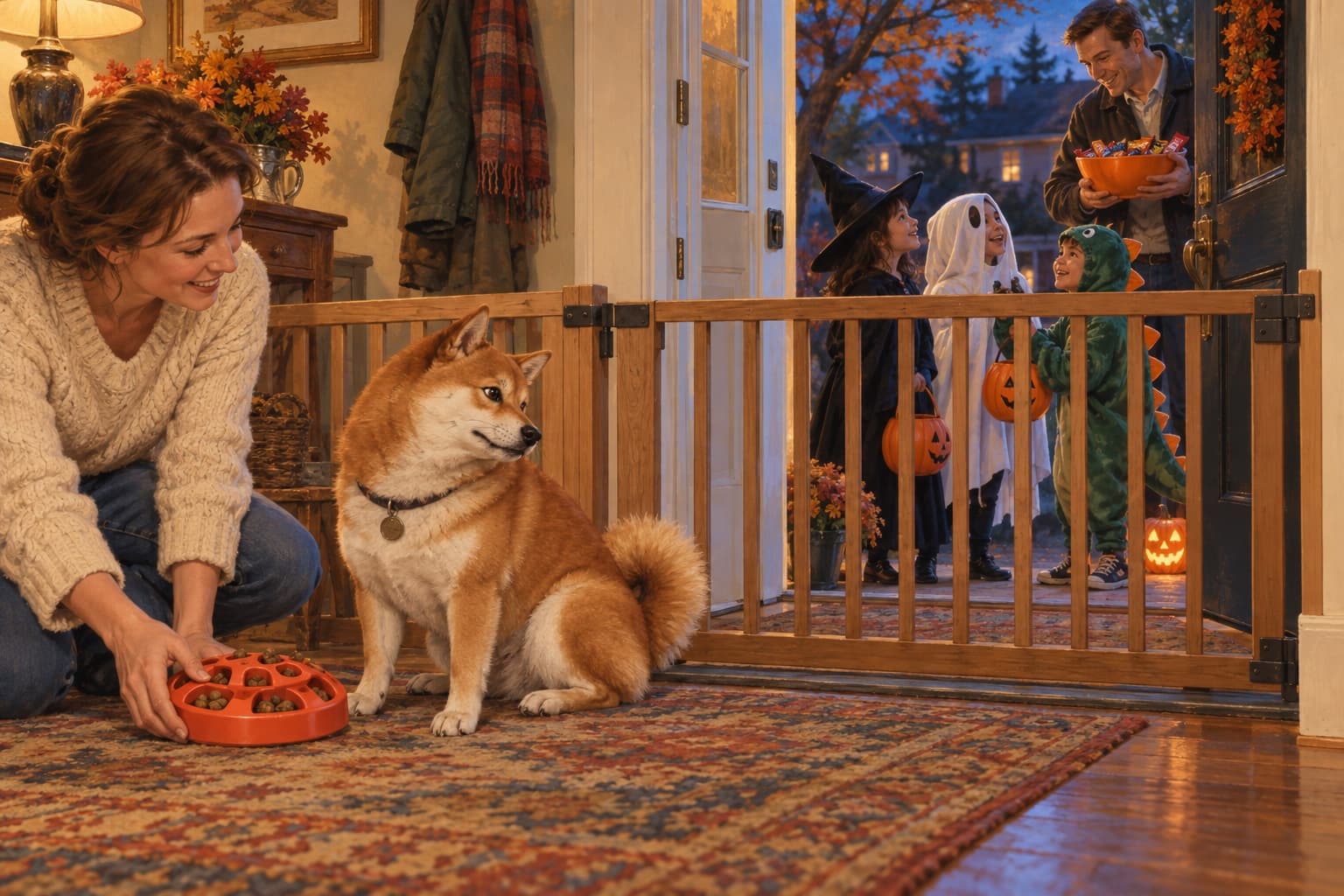
Halloween dos and don'ts for dogs: what happens when a dog gets into the candy, what on the counter is actually fine, and how to get through trick-or-treat night without a vet visit.
Halloween is a short holiday with a long list of ways for a dog to get hurt. Most of them come down to two things: a bowl of candy within reach, and a front door that opens forty times in two hours. Pet Poison Helpline reports that its call volume climbs sharply during Halloween week, and chocolate has been its single most common call for more than a decade, with dogs making up about 95 percent of those calls.[1] Nearly every one of those calls was preventable.
This article covers the candy first, because that is where the real danger is. Then it covers costumes, the doorbell, decorations, and what to do in the first hour if your dog eats something anyway.
The candy
Chocolate
Chocolate contains theobromine and caffeine, and dogs clear theobromine slowly. The half-life in a dog is about 17.5 hours, which is why signs can keep building long after the candy is gone.[2]
How much it takes depends on the kind of chocolate and the size of the dog. The Merck Veterinary Manual gives these figures for methylxanthine content: milk chocolate about 64 mg per ounce, semisweet and dark about 150 to 160 mg per ounce, unsweetened baking chocolate about 440 mg per ounce, and cocoa powder about 807 mg per ounce. White chocolate has almost none.[2]
Mild signs such as vomiting, diarrhea, and heavy drinking can start around 20 mg per kilogram of body weight. Heart effects appear at 40 to 50 mg per kilogram, and seizures at 60 mg per kilogram and above.[2] Working from those numbers:
- A 20-pound dog reaches the mild-signs threshold at roughly 3 ounces of milk chocolate, a little over 1 ounce of dark chocolate, or less than half an ounce of baking chocolate.
- A 60-pound dog reaches it at roughly 8 to 9 ounces of milk chocolate, 3 to 4 ounces of dark, or just over an ounce of baking chocolate.
Those are the doses where signs begin. There is no safe amount. Merck notes that severe signs and death have occurred at much lower doses than the averages suggest, and a bag of fun-size bars adds up faster than most people expect.[2] If you are not sure how much was eaten, count the wrappers against what was in the bowl and call one of the poison lines with the dog's weight and the chocolate type. They will do the math.
Signs usually show up 6 to 12 hours after the dog eats it: restlessness, vomiting, diarrhea, heavy drinking and urinating, then a racing heart, tremors, and in bad cases seizures.[2] A vet can induce vomiting if the dog is seen within about two hours of eating it, which is one reason to call right away rather than wait and watch.[2]
Sugar-free candy and gum
Xylitol, a sweetener used in sugar-free gum, mints, some candy, some baked goods, and some peanut butters, causes a fast insulin release in dogs and a dangerous drop in blood sugar. The FDA says signs can begin within 10 to 60 minutes of ingestion, though in some cases serious effects do not appear for 12 to 24 hours.[3] Large amounts can also damage the liver, with liver injury showing up in the 12-to-24-hour window.[4]
Early signs are vomiting, then weakness, staggering, collapse, and seizures.[3] Xylitol is sometimes listed on labels as "birch sugar," "birch extract," or "wood sugar."[1] A single piece of gum can matter for a small dog. The FDA's advice is to call a vet, emergency clinic, or poison line immediately and get the dog seen right away, because serious effects can be delayed 12 to 24 hours and the dog may need to be hospitalized for monitoring.[3]
Raisins
Chocolate-covered raisins, trail mix, and oatmeal raisin cookies all show up in Halloween bags. Grapes and raisins can cause acute kidney failure in dogs, and there is no established safe amount.[1] The suspected toxin is tartaric acid, which dogs cannot clear well and which varies widely from one grape to the next, so the same handful can be harmless to one dog and serious for another.[5] Merck's working estimate is that more than one grape or raisin per 10 pounds of body weight may put the kidneys at risk.[5]
Vomiting usually starts within 6 to 12 hours. Kidney failure can follow within one to three days, and by then treatment is much harder.[5] Call as soon as you know. Do not wait for signs.
The same trail mix and cookies often carry macadamia nuts. In dogs they cause weakness, wobbling, vomiting, tremors, and a high temperature within about 12 hours. The syndrome is rarely fatal and most dogs recover within a day or two, but it is frightening to watch and worth a call.[15]
Everything else in the bowl
Candy corn, gummies, caramels, lollipops, and the rest are not poisonous in the usual sense, but a large amount of sugar and fat at once can set off pancreatitis, and that can take two to four days to show.[1] Pancreatitis means vomiting, a dog that will not eat, a painful belly, and sometimes a "prayer" posture with the front end down and the back end up.[6] Merck lists dietary indiscretion, which usually means the trash or the table, as a common risk factor.[6]
The wrappers are a separate problem. Foil, cellophane, and lollipop sticks can lodge in the gut and cause an obstruction that may require surgery.[1] Signs are vomiting, not wanting to eat, straining or not passing stool, and lethargy. If your dog cleaned out a candy bowl, assume some wrappers went with it and tell the vet so.
What is actually fine
A few things that are safe in sensible amounts for a healthy adult dog:
- Plain canned pumpkin, not pie filling. Pie filling is sweetened and spiced. A spoonful of the plain kind on dinner is fine.[16]
- Apple slices with the seeds and core removed, and carrot sticks.[16]
- A frozen stuffed toy with the dog's own kibble and a smear of peanut butter whose label does not list xylitol.
- Commercial dog treats, portioned.
Keep all of this to a small fraction of the day's food. This is something to work on in the back room while the door is busy. It is not a second dinner.
Costumes
Plenty of dogs tolerate a costume and some seem to enjoy the attention. Plenty do not. The ASPCA's rule is simple: do not dress a pet in a costume unless the pet is fine with it.[7]
If you do, check three things. The costume should not limit movement, sight, or the ability to breathe and bark.[7] On a flat-faced dog, anything that covers the muzzle or holds heat is a bad idea on any night. It should have no small, dangling, or chewable pieces, and the AKC specifically warns about glitter and dyes that can be swallowed or irritate the skin.[8] And the dog should be supervised the whole time it is on.[8]
Put it on a few days ahead for a trial run.[7] Signs the dog is not happy include panting, freezing or refusing to move, flattened ears, and pawing at or repeatedly trying to get out of the costume.[8] If you see those, take it off and switch to a bandana. Nobody at the door will know the difference.
One more item from the dog's side of things: the small toys and accessories that come with human costumes are a choking hazard, and some of the plastic is not safe to chew.[7]
The door
The front door is the most dangerous object in the house on Halloween night. It opens over and over, there are strangers in masks on the other side, and a dog that is frightened or excited can slip out past a child's legs in a second.
The standard advice from both the ASPCA and Pet Poison Helpline is to put the dog in a separate, comfortable room or crate away from the door during trick-or-treat hours.[7, 1] Give the dog something to chew or a food puzzle to work on while it is in there. If your dog is the rare one who loves every visitor, use a leash or a baby gate anyway. It is one night.
If your dog already comes apart at the doorbell or at fireworks, call your vet this week rather than on the 31st. There are short-acting options for a night like this, and they take a little planning.
Before the night, check the ID tag and the microchip registration. A 2009 study of 7,704 microchipped animals that came into 53 shelters found that owners were located for about 73 percent of them, and the most common reason the rest were not was an incorrect or disconnected phone number in the chip registry.[9] If you have moved or changed numbers since the chip went in, update the registry this week. If you walk the dog after dark, use a reflective collar and a short leash.[7]
Decorations and the yard
- Candles and jack-o'-lanterns. A wagging tail or a curious nose can knock one over.[7] Battery tea lights look the same from the sidewalk.
- Fake cobwebs can tangle a dog or cause a blockage if eaten.[1]
- Battery-powered decorations. A chewed button or coin battery causes chemical burns in the mouth and gut. If one is swallowed, call right away.[1]
- Glow sticks and glow jewelry. The liquid inside is dibutyl phthalate, and in the amount a glow stick holds it is an irritant more than a poison. It tastes terrible, though, and a dog that bites one will froth, drool, retch, and sometimes vomit.[10, 18] Wipe the mouth with a wet cloth, offer water or a treat to cut the taste, and bathe off any residue so the dog does not re-dose itself grooming.[18] Check for the plastic casing too. Swallowed pieces can cause a blockage.[10]
- Decorative corn and gourds. Corn cobs are a well-known cause of intestinal blockage in dogs, and once chewed into pieces they can be hard to pick out on an X-ray.[17] Keep the porch display where the dog cannot reach it.
- Old pumpkins. A carved pumpkin left on the porch grows mold, and some molds produce tremorgenic mycotoxins that cause tremors and seizures within hours.[1, 11] Throw pumpkins out before they go soft.
If your dog gets into something anyway
- Get the dog away from the rest of it. Pick up what is left and the wrappers.
- Figure out what and how much. Count what remains against what was there, note the type of chocolate or the ingredient list on the package, and know the dog's weight.
- Call. Your own vet if they are open, an emergency clinic if not, or one of the two national poison lines, which run 24 hours a day:
- ASPCA Animal Poison Control Center, (888) 426-4435. A consultation fee may apply.[12]
- Pet Poison Helpline, (855) 764-7661. The fee is $99 per incident and covers follow-up calls with you and your vet.[13]
- Do not make the dog vomit on your own unless a vet or poison line tells you to and tells you how. The ASPCA's position is that hydrogen peroxide is the only method that works at home for dogs and that even peroxide should be used only under veterinary guidance, because too much causes its own damage. Mustard, toast, and milk do not work, and salt can cause its own poisoning.[14] Never try it on a dog that is drowsy, unsteady, or seizing.
Know before the night which emergency clinic is open and how to get there. Keep the package or the wrapper. Take it to the clinic. The ingredient list and the weight on the label answer most of the questions the vet will ask.
When it is an emergency
Go now, do not call first, if the dog is collapsed, seizing, having trouble breathing, or badly unsteady on its feet. Call first and expect to go if the dog ate dark or baking chocolate, anything sugar-free, or raisins in any amount, or if a small dog ate any chocolate at all. Call and watch if a large dog ate a small amount of milk chocolate, but do not go to bed assuming it is fine. The six-to-twelve-hour onset means the trouble can arrive at 2 a.m.
The short version
- Candy goes up high, in a cupboard, tonight and for the rest of the week. Check the kids' rooms.
- Read the label on anything sugar-free. Xylitol is an emergency.
- Raisins in any form are an emergency.
- Chocolate: darker is worse, smaller dog is worse, call with the weight and the type.
- Dog in a back room with a chew during trick-or-treat hours.
- ID tag on, microchip registry current.
- Costume only if the dog is fine with it, and supervised.
- Candles out of reach, pumpkins in the trash before they rot.
- Two numbers on the fridge: (888) 426-4435 and (855) 764-7661. The nearest 24-hour clinic's address next to them.
Sources
- Pet Poison Helpline, "Halloween Dangers to Dogs & Cats." https://www.petpoisonhelpline.com/pet-owners/seasons/halloween/
- Merck Veterinary Manual, "Chocolate Toxicosis in Animals." https://www.merckvetmanual.com/toxicology/food-hazards/chocolate-toxicosis-in-animals
- U.S. Food and Drug Administration, "Paws Off Xylitol; It's Dangerous for Dogs." https://www.fda.gov/consumers/consumer-updates/paws-xylitol-its-dangerous-dogs
- ASPCA Animal Poison Control Center, "People Foods to Avoid Feeding Your Pets." https://www.aspca.org/pet-care/animal-poison-control/people-foods-avoid-feeding-your-pets
- Merck Veterinary Manual, "Raisin and Grape Toxicosis in Dogs." https://www.merckvetmanual.com/toxicology/food-hazards/raisin-and-grape-toxicosis-in-dogs. The tartaric acid hypothesis was put forward by Wegenast C, Meadows I, Anderson R, and Southard T, "Unique sensitivity of dogs to tartaric acid and implications for toxicity of grapes," Journal of the American Veterinary Medical Association, April 1, 2021, 258(7):704-707, doi:10.2460/javma.258.7.704, with supporting case reports in Wegenast et al., Journal of Veterinary Emergency and Critical Care 32(6):812-816, 2022.
- Merck Veterinary Manual, "Pancreatitis in Dogs and Cats." https://www.merckvetmanual.com/digestive-system/the-exocrine-pancreas/pancreatitis-in-dogs-and-cats
- ASPCA, "Halloween Safety Tips." https://www.aspca.org/pet-care/general-pet-care/halloween-safety-tips
- American Kennel Club, "Dog Halloween Costume Safety." https://www.akc.org/expert-advice/lifestyle/dog-halloween-costume-safety/
- Lord LK, Ingwersen W, Gray JL, Wintz DJ, "Characterization of animals with microchips entering animal shelters," Journal of the American Veterinary Medical Association, 2009, 235(2):160-167; summarized by The Ohio State University. https://news.osu.edu/microchips-result-in-higher-rate-of-return-of-shelter-animals-to-owners/
- Pet Poison Helpline, "Glow Jewelry." https://www.petpoisonhelpline.com/?p=1061
- Merck Veterinary Manual, "Tremorgenic Neuromycotoxicosis in Dogs." https://www.merckvetmanual.com/toxicology/mycotoxicoses/tremorgenic-neuromycotoxicosis-in-dogs
- ASPCA Animal Poison Control Center. https://www.aspca.org/pet-care/animal-poison-control
- Pet Poison Helpline, frequently asked questions. https://www.petpoisonhelpline.com/faq/
- ASPCA, "Is It Ever Safe to Induce Vomiting?" https://www.aspca.org/news/it-ever-safe-induce-vomiting
- Merck Veterinary Manual, "Macadamia Nut Toxicosis in Dogs." https://www.merckvetmanual.com/toxicology/food-hazards/macadamia-nut-toxicosis-in-dogs
- American Kennel Club, "Fruits and Vegetables Dogs Can or Can't Eat." https://www.akc.org/expert-advice/nutrition/fruits-vegetables-dogs-can-and-cant-eat/
- MSPCA-Angell, Tsai S, "Radiographic Appearance of Common GI Foreign Bodies in Dogs and Cats." https://www.mspca.org/wp-content/uploads/2023/10/Tsai_Radiographic-Appearance-of-Common-GI-Foreign-Bodies-in-Dogs-and-Cats_4-12-23.pdf
- VCA Animal Hospitals, "True or False: Glowsticks Are Horribly Poisonous to Pets." https://vcahospitals.com/resources/lifestyle-dog/hazards-safety/true-or-false-glowsticks-are-horribly-poisonous-to-pets
This article is general information, not veterinary advice. Your own veterinarian knows your dog.