Guide · Crescent Moon Shibas
The Loudest Night of the Winter
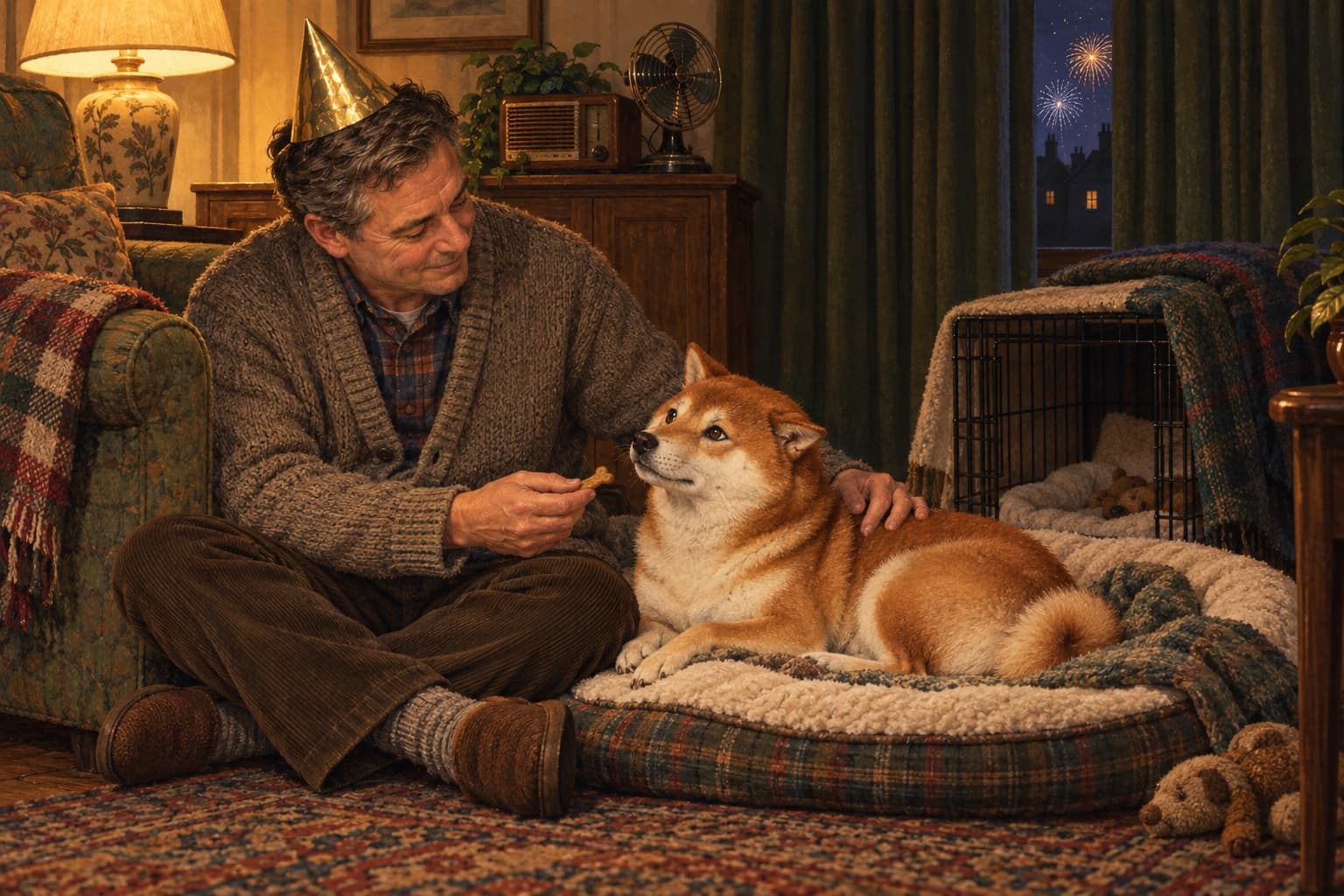
New Year's Eve dos and don'ts for dogs: fireworks, a late night, a house full of glasses at nose height, and the morning after.
New Year's Eve is two holidays stacked on top of each other. The first is a party, with the same food and drink problems as the rest of December and a few new ones. The second is the loudest night of the winter. In a survey of 1,225 dog owners, 52 percent of dogs were at least partly afraid of fireworks, and one fearful dog in four was still not back to normal by the next morning.[1] A frightened dog bolts, and a dog that bolts on New Year's Eve is loose in the dark and the cold.
This article covers the noise first, then the door, then the party, then the morning after, then what to do in the first hour if the dog gets into something.
The noise
What fear looks like
Most dogs do not howl when the fireworks start, so the fear is easy to miss. A video study of pet dogs on New Year's Eve found the clearest sign was ears held back, followed by moving around more and panting. Most of the dogs never made a sound, and plenty never hid.[2] If the dog is up, moving, panting in a cool room, and will not settle, that is the fear, whether or not there is any noise coming out.
The night of
Merck's approach to a noise phobia starts with the environment: pick a safe place, build good associations with it long before it is needed, take the dog there before the noise starts, and cover the sound with white noise or soundproofing.[3] In most houses that means an interior room, a finished basement, or a covered crate, with a fan running, the curtains closed, and a radio or television on. The ASPCA's version is the same: an inside room away from the excitement, soft music, no windows if you have one.[4] Stay home if you can. Do not take the dog to a display, and do not leave a fearful dog alone in the yard.
Comforting the dog is fine. In the same survey, petting and talking to a frightened dog neither helped nor hurt how the fear progressed over time, so the old advice that comforting rewards the fear has no support.[1, 5] The same survey asked what actually worked. Owners rated feeding treats and playing during the noise as effective about 71 percent of the time, relaxation training about 69 percent, prescription medication about 69 percent, and noise recordings about 54 percent. Pressure wraps came in at 44 percent, and the herbal, homeopathic, and pheromone products were rated effective by a third of users or fewer and had no measurable effect on how the fear developed.[5] So have the good treats out and a game ready, and start before the first bang.
Medication
For a dog that comes apart, book a vet appointment this week. By 11 p.m. on the 31st it is too late. Merck lists several drugs used for noise aversion, including a dexmedetomidine gel approved by the FDA for this purpose, and notes that a rapid-onset medication makes sense for a predictable event like fireworks and that any as-needed drug should be trial-run on a quiet day first, so you know how your dog responds.[3] Human sedatives from the medicine cabinet are no substitute. Pet Poison Helpline reports that about half the dogs that get into sleep aids become agitated instead of sedated.[20]
The long game
Firework fear usually starts young. In the same survey, 45 percent of affected dogs showed it before their first birthday. Dogs whose owners did any preventive noise training as puppies scored a median of 1 out of 5 on the fear scale as adults. Dogs trained as adults scored 2. Dogs with no preventive training scored 4. Only one owner in five had done any training as a puppy.[1] If you have a puppy this winter, start now.
The door and the cold
Every guest arriving and leaving is an open door, and a dog that is already on edge from the noise is the one that goes through it. The AVMA's advice for holiday parties is to watch the exits closely, put a nervous dog in another room before guests arrive, and make sure the tag and the microchip carry your current phone number.[6] In the 2009 shelter study of 7,704 microchipped animals, owners were found for 73 percent, and the most common reason the rest were not was a wrong or disconnected number in the registry.[7]
Every trip outside on the 31st is on a leash, including the last one before bed in a fenced yard. A panicked dog clears a fence it has never tried. Keep the collar and tag on indoors that night too.
A dog that gets out on New Year's Eve is out in January weather. The body pulls blood from the extremities in the cold, leaving ears, tail, and paws exposed, and short-coated, small, and older dogs are at the most risk.[8] Walk the dog early, before dark and before the noise, and keep the walk short on a cold night. Rinse the paws afterward. Ice melt irritates the pads, and a dog that licks a lot of it off can get anything from an upset stomach to tremors with some products, with the calcium-based ones the harshest on skin.[8, 9]
If the dog does get out, do not chase; a frightened dog runs from a running person. Open the door you came out of, call once in a normal voice, and put food and a worn piece of clothing on the step. Then call the microchip registry to flag the chip, call the shelters and emergency clinics in the morning, and post a recent photo locally. The registry phone number is what brings the dog back once a shelter or a clinic scans the chip.[7]
The party
The glasses
Champagne, beer, and cocktails sit on coffee tables and floors all night. Alcohol signs in a dog start within 30 to 60 minutes: vomiting, staggering, disorientation, then in a bad case low body temperature, slow breathing, seizures, and coma. Making the dog vomit only helps in the first 20 to 40 minutes, and only before signs start.[10] Pour out abandoned drinks as you clear them.
The edibles
Marijuana is legal in a lot of places now and it shows up at parties as gummies, baked goods, and chocolate. Dogs react to THC differently from people, and harder, with signs beginning one to two hours after eating it, or up to four hours on an empty stomach: a wobbly, dull dog that dribbles urine, flinches at sound and touch, and may have a slow heart rate and a low temperature. Deaths are extremely rare, but the dog can be sick for one to three days.[11] A chocolate or raisin edible brings its own poison along.[12, 14] Tell the vet what the dog ate. The clinic needs to know to treat the dog and has no interest in anything else.
The snacks
The cheese board carries grapes, which can threaten a dog's kidneys at one grape per 10 pounds of dog, with kidney failure following within one to three days.[12] The nut bowl may hold macadamias, which cause weakness, wobbling, and tremors within about 12 hours.[13] With chocolate, darker is worse and a smaller dog is worse. Merck's figures put the first signs for a 20-pound dog at about 3 ounces of milk chocolate or a little over an ounce of dark.[14] Onion dip and anything built on onion or garlic damages red blood cells, and the anemia takes several days to show.[15, 26] Salty snacks in quantity mean heavy drinking, vomiting, and in a bad case tremors and seizures.[15] The wings, the sausage, and the fatty leftovers are a pancreatitis problem that announces itself one to four days later.[16]
Glow sticks, poppers, and confetti
Glow sticks and glow jewelry hold dibutyl phthalate. The amount in one stick is usually not life-threatening, but it tastes terrible, and a dog that bites one will drool, froth, and retch.[25] Wipe the mouth, offer water or a treat, bathe off any residue, and check that the plastic casing did not go down too.[17, 18] Poppers, streamers, and confetti frighten a dog and, if eaten, can block a gut. The ASPCA's warning about swallowed confetti is written for cats, but a small dog with a mouthful of streamers is in the same spot.[19]
The guests' bags
A purse on the floor or a coat on the bed holds pills, sugar-free gum and mints sweetened with xylitol, nicotine pouches, and vapes. The ASPCA's advice is to ask guests to keep medications in a closed cabinet rather than in a bag.[19] Nearly half of all the calls Pet Poison Helpline takes involve human medications.[20]
The morning after
New Year's Day has its own hazards. The first is the pill bottle on the nightstand. Pet Poison Helpline's warning on ibuprofen and naproxen is that even one or two pills can cause serious harm to a pet, with stomach and intestinal ulcers and kidney failure the result.[20] Merck's figures for ibuprofen in dogs put stomach signs at a single dose of 100 to 125 mg per kilogram and kidney failure at 175 to 300. One 200 mg tablet is a toxic dose for a 4-pound dog, and a handful is a toxic dose for a 20-pound one. Naproxen is worse, because a dog clears it so slowly that one dose lingers for days.[21] Never give a dog a human pain reliever, and keep yours off the nightstand.
The second is the cleanup. Plates, glasses, and the trash from the night before are all at dog height until somebody gets up. Bag it before bed or put the dog in the bedroom with you.
The third is the walk. Spent fireworks and the duds that did not go off litter sidewalks and parks on January 1, and a dog that eats one can get anything from an upset stomach to organ injury or seizures, depending on what was in it.[27] Keep the dog on a short leash and off the debris. Then feed the normal breakfast at the normal time. The dog did not stay up by choice.
If the dog gets into something anyway
- Get the dog away from the rest of it and pick up what is left.
- Figure out what and how much. Keep the package, the glass, or the gummy wrapper, and know the dog's weight.
- Call. Your own vet if they are open, the emergency clinic if not, or one of the two national poison lines, which run all night and all of New Year's Day:
- ASPCA Animal Poison Control Center, (888) 426-4435. A consultation fee may apply.[22]
- Pet Poison Helpline, (855) 764-7661. The fee is $99 per incident and covers follow-up calls with you and your vet.[23]
- Do not make the dog vomit on your own unless a vet or poison line tells you to and tells you how. Hydrogen peroxide is the only home method that works for dogs and it is only safe under veterinary direction. Mustard, toast, and milk do not work, and salt can cause its own poisoning.[24] No vet will tell you to try it on a dog that is drowsy, staggering, or seizing, which rules out most of the dogs that got into the bar or the edibles.
Know before the night which emergency clinic is open and how to get there. That is the AVMA's first piece of holiday advice.[6]
When it is an emergency
Go now if the dog is collapsed, seizing, having trouble breathing, or so unsteady it cannot stand. Call first and expect to go for alcohol, an edible, grapes in any amount, a human pain reliever or any other pill, or dark or baking chocolate. Call and watch for a dog that is frightened but physically fine, and for the one that got into the wings and the dip, where the trouble comes two or three days later.
The short version
- Walk early, feed on time, and set up the quiet room before dark.
- Dog in the quiet room with white noise, treats, and a game before the first firework.
- Comfort the dog. It does not make the fear worse.
- A dog that panics needs a vet appointment this week. Nothing from your own medicine cabinet.
- Collar and tag on all night, chip registry current, exits watched at every arrival and departure, leash for every trip outside.
- Glasses poured out as they are abandoned, edibles locked up, and guests' bags closed and off the floor.
- Grapes, macadamias, chocolate, and onion dip off the low tables.
- Glow sticks and poppers away from the dog.
- Pills off the nightstand. Never a human pain reliever.
- Normal breakfast on January 1, and a short leash past the firework debris.
- Two numbers on the fridge: (888) 426-4435 and (855) 764-7661. The all-night clinic's address beside them.
Sources
- Riemer S, "Not a one-way road: Severity, progression and prevention of firework fears in dogs," PLoS ONE, 2019, 14(9):e0218150, doi:10.1371/journal.pone.0218150. https://journals.plos.org/plosone/article?id=10.1371/journal.pone.0218150
- Gähwiler S, Bremhorst A, Tóth K, Riemer S, "Fear expressions of dogs during New Year fireworks: a video analysis," Scientific Reports, 2020, 10:16035, doi:10.1038/s41598-020-72841-7. https://pmc.ncbi.nlm.nih.gov/articles/PMC7525486/
- Merck Veterinary Manual, "Behavior Problems of Dogs" (fears and phobias; noise aversion). https://www.merckvetmanual.com/behavior/behavior-of-dogs/behavior-problems-of-dogs
- ASPCA, "Fourth of July Safety Tips." https://www.aspca.org/pet-care/general-pet-care/fourth-july-safety-tips
- Riemer S, "Effectiveness of treatments for firework fears in dogs," Journal of Veterinary Behavior, 2020, 37:61-70, doi:10.1016/j.jveb.2020.04.005. Summary by the American Veterinary Society of Animal Behavior: https://avsab.org/survey-shows-which-treatments-are-effective-for-fireworks-fears-in-dogs/
- American Veterinary Medical Association, "Winter holiday pet safety." https://www.avma.org/resources-tools/pet-owners/petcare/holiday-pet-safety
- Lord LK, Ingwersen W, Gray JL, Wintz DJ, "Characterization of animals with microchips entering animal shelters," Journal of the American Veterinary Medical Association, 2009, 235(2):160-167; summarized by The Ohio State University. https://news.osu.edu/microchips-result-in-higher-rate-of-return-of-shelter-animals-to-owners/
- Pet Poison Helpline, "Winter Hazards for Your Pet." https://www.petpoisonhelpline.com/uncategorized/winter-hazards-pet/
- Chambers C, Pet Poison Helpline, "Ice Melts: Are They Really Safe for Pets?" https://www.petpoisonhelpline.com/uncategorized/really-safe-ice-melt/
- Merck Veterinary Manual, "Toxicoses from Alcohols in Animals." https://www.merckvetmanual.com/toxicology/toxicoses-from-household-hazards/toxicoses-from-alcohols-in-animals
- Merck Veterinary Manual, "Toxicosis in Dogs and Cats From Tetrahydrocannabinol (THC)." https://www.merckvetmanual.com/toxicology/toxicoses-from-human-recreational-drugs/toxicosis-in-dogs-and-cats-from-tetrahydrocannabinol-thc
- Merck Veterinary Manual, "Raisin and Grape Toxicosis in Dogs." https://www.merckvetmanual.com/toxicology/food-hazards/raisin-and-grape-toxicosis-in-dogs
- Merck Veterinary Manual, "Macadamia Nut Toxicosis in Dogs." https://www.merckvetmanual.com/toxicology/food-hazards/macadamia-nut-toxicosis-in-dogs
- Merck Veterinary Manual, "Chocolate Toxicosis in Animals." https://www.merckvetmanual.com/toxicology/food-hazards/chocolate-toxicosis-in-animals
- ASPCA Animal Poison Control Center, "People Foods to Avoid Feeding Your Pets." https://www.aspca.org/pet-care/animal-poison-control/people-foods-avoid-feeding-your-pets
- Pet Poison Helpline, "Is table food poisonous for dogs?" https://www.petpoisonhelpline.com/pet-safety-tips/is-table-food-poisonous-for-dogs/
- VCA Animal Hospitals, "True or False: Glowsticks Are Horribly Poisonous to Pets." https://vcahospitals.com/resources/lifestyle-dog/hazards-safety/true-or-false-glowsticks-are-horribly-poisonous-to-pets
- Pet Poison Helpline, "Glow Jewelry." https://www.petpoisonhelpline.com/?p=1061
- ASPCA, "Holiday Safety Tips." https://www.aspca.org/pet-care/general-pet-care/holiday-safety-tips
- Pet Poison Helpline, "Top 10 Human Medications Poisonous to Pets." https://www.petpoisonhelpline.com/pet-safety-tips/top-10-human-medications-poisonous-to-pets/
- Merck Veterinary Manual, "Toxicoses from Human Analgesics in Animals." https://www.merckvetmanual.com/toxicology/toxicoses-from-human-analgesics/toxicoses-from-human-analgesics-in-animals
- ASPCA Animal Poison Control Center. https://www.aspca.org/pet-care/animal-poison-control
- Pet Poison Helpline, frequently asked questions. https://www.petpoisonhelpline.com/faq/
- ASPCA, "Is It Ever Safe to Induce Vomiting?" https://www.aspca.org/news/it-ever-safe-induce-vomiting
- Pet Poison Helpline, "Halloween Dangers to Dogs & Cats" (glow sticks and glow jewelry). https://www.petpoisonhelpline.com/pet-owners/seasons/halloween/
- Merck Veterinary Manual, "Allium spp Toxicosis in Animals." https://www.merckvetmanual.com/toxicology/food-hazards/allium-spp-toxicosis-in-animals
- Pet Poison Helpline, "Fireworks." https://www.petpoisonhelpline.com/poison/fireworks/
This article is general information, not veterinary advice. Your own veterinarian knows your dog.