Guide · Crescent Moon Shibas
Nobody Feeds the Dog
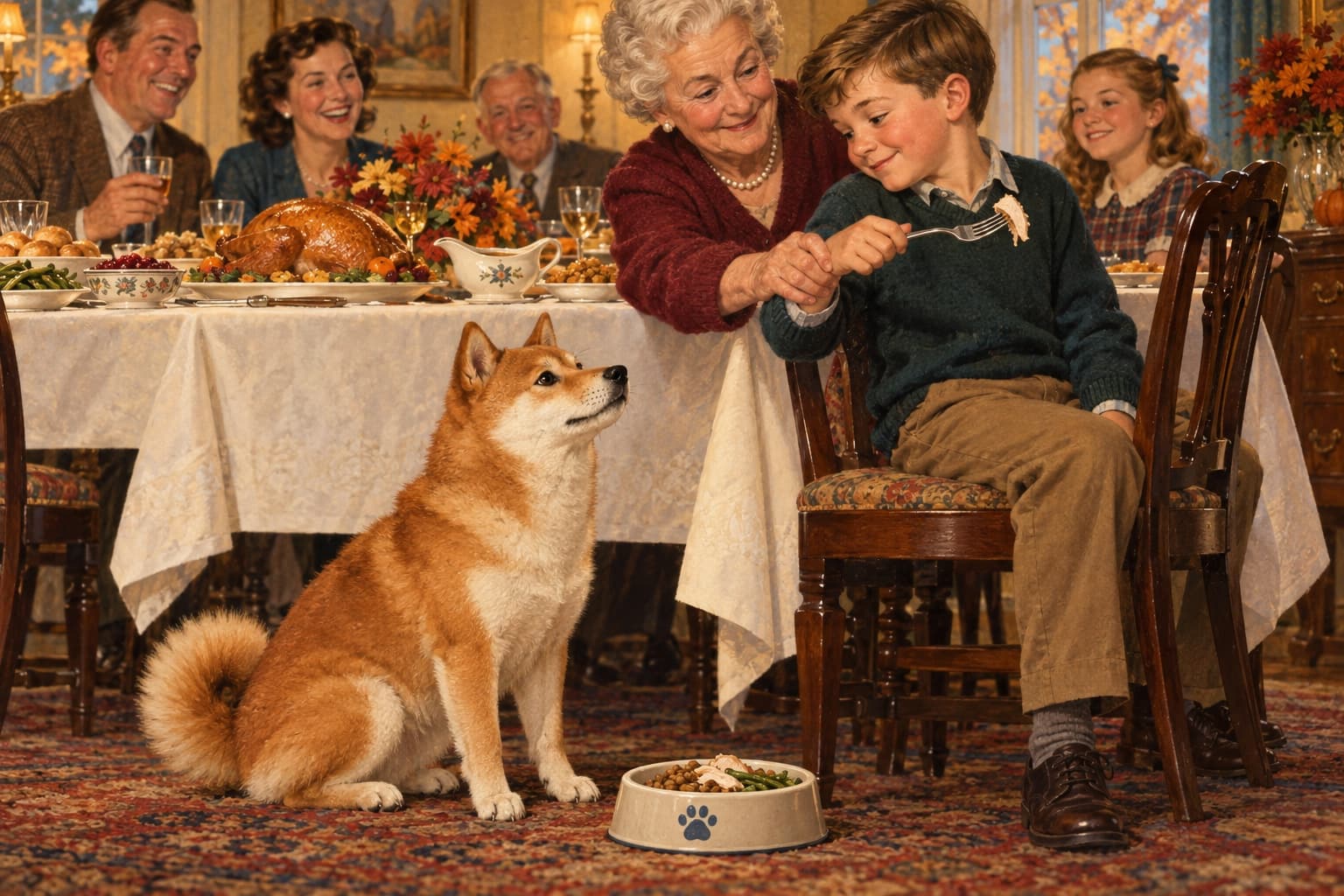
Thanksgiving dos and don'ts for dogs: what on the table can hurt a dog, what a plain bite looks like, and how to run a full house without a trip to the emergency clinic.
Most of the Thanksgiving food sits on a table at nose height for six hours. Pet Poison Helpline reports that it takes more poisoning calls in November and December than at any other time of year.[23] The risks on the day are a houseful of people who each think one bite will not hurt, a trash can with a turkey carcass in it, and a dog with all afternoon to work on both.
This article covers the plate first, then the houseful, the kitchen and the trash, travel, and what to do in the first hour if the dog gets into something.
The plate
Turkey, skin, and bones
Plain, boneless, skinless turkey is fine for most dogs in a small portion.[1] The trouble is everything attached to it. Skin, drippings, gravy, and the fat off the carving board are hard for a dog to digest, and the AVMA notes that sometimes even a small amount can set off pancreatitis.[1] Pet Poison Helpline notes there is no toxin in fatty table food. The danger is pancreatitis, and the vomiting that announces it typically shows up one to four days after the meal.[2] By then the holiday is over and the connection is easy to miss.
Pancreatitis means a dog that stops eating, vomits, has a sore belly, and may stand with the front end down and the back end up.[3] Merck lists dietary indiscretion as a common risk factor and names Miniature Schnauzers, Yorkshire Terriers, Cocker Spaniels, Dachshunds, and Poodles among the breeds that get it more often.[3] Treated early the outlook is good. Treated late it can be fatal.[2]
Cooked poultry bones are a separate problem. They splinter, and they can choke a dog or block or tear the gut.[1, 17] The FDA lists bones and corn cobs together as things that get stuck in the esophagus, stomach, or intestines.[14] No bones from the bird, raw or cooked, at the table or in the trash.
Stuffing, onions, and garlic
Stuffing and dressing are built on onion and garlic, and so are most gravies, green bean casseroles, and mashed potatoes made the good way. Every member of the onion family damages a dog's red blood cells and can cause anemia. Raw, cooked, dehydrated, and granulated onion and garlic have all poisoned dogs, concentrated forms such as onion powder are the usual cause, and garlic is three to five times as toxic as onion by weight.[24]
The amount matters. The published review cites two thresholds for dogs: clinical signs after 15 to 30 grams of raw onion per kilogram of body weight, and toxicosis consistently seen once a dog eats more than half a percent of its body weight in onion at one sitting.[4] The conservative figure puts a 20-pound dog at about an ounce and a half of onion, roughly what is in a full plate of dressing. The signs lag. Vomiting and a dull dog may come first, but the anemia takes several days to bottom out, and by then you are looking at pale gums, weakness, fast breathing, and dark urine.[4] The same paper notes that Japanese breeds such as the Akita and the Shiba Inu carry a red-cell trait that makes them more susceptible than most.[4]
Gravy, butter, and the casseroles
Gravy, butter, bacon, cream, drippings, and anything cooked in them belong to the pancreatitis column above.[2] Mashed potatoes with butter, cream, onion, or garlic are a people food.[17] Green bean casserole is onion, cream, and fried onions on top. Sweet potato casserole is sugar and marshmallows. The plain versions of all three are fine. The recipe versions are not.[17] Ham belongs on the same list: it is fat and salt together, and the AKC puts it on the keep-away side of the table.[17]
Salt, brine, and bouillon
A brined bird, the brine itself, pan drippings, and bouillon cubes carry a lot of sodium. Pet Poison Helpline lists turkey brine as a cause of salt poisoning.[13] The ASPCA warns that bouillon-heavy stock and gravy can cause stomach trouble and seizures, and that too much salt in general means heavy drinking, vomiting, diarrhea, tremors, and seizures.[11, 19] Keep the brine bucket covered and the dog out of the drippings.
Raw dough and raw turkey
Rising bread dough is a real emergency. A dog's stomach is warm and wet, so the yeast keeps working after the dough is swallowed. The ball expands and the yeast produces alcohol, which the dog absorbs.[5] Early signs are a swollen belly, retching with nothing coming up, and a dull dog. Then come staggering, disorientation, and in bad cases collapse, low body temperature, and seizures.[5] Merck notes that the expanding mass can also trigger bloat in susceptible breeds.[5] Any yeast dough that is proofing on the counter is within reach of a dog on its hind legs.
Raw or undercooked turkey and raw egg batter can carry Salmonella.[11] The CDC advises against feeding raw pet food of any kind and notes that the germs spread around the kitchen and make the people sick too.[15] Keep the dog out of the kitchen while the bird is being handled, and wash the dog's bowl like you would a cutting board.
Dessert
Most of the true poisons on the day are on the dessert table.
- Sugar-free anything. Xylitol in sugar-free baked goods and sugar-free desserts causes a fast drop in blood sugar in dogs, with signs starting in 10 to 60 minutes and sometimes delayed 12 to 24 hours, and a large dose can damage the liver within a day.[8, 19] Read the label on anything marked sugar-free, and call right away on any exposure.[17]
- Chocolate. Dark chocolate and a small dog are the worst combination. Mild signs can start around 20 mg of methylxanthines, which means theobromine plus caffeine, per kilogram of body weight. For a 20-pound dog that is about 3 ounces of milk chocolate or a little over 1 ounce of dark.[9]
- Raisins and grapes. Fruit salad, stuffing with raisins, oatmeal cookies, trail mix on the coffee table. Merck's working estimate is that more than one grape or raisin per 10 pounds of body weight may be enough to injure the kidneys, with vomiting in 6 to 12 hours and kidney failure within one to three days.[7]
- Macadamia nuts. Cookies and the nut bowl. Weakness, wobbling, tremors, and a high temperature within about 12 hours, rarely fatal but frightening.[10]
- Pumpkin pie. The pumpkin is fine. The pie is sugar, fat, dairy, and spice. Nutmeg in large amounts causes vomiting, agitation, a fast heart rate, trouble walking, and hallucinations.[18] The pinch in a slice of pie is nowhere near that amount, but a dog that eats the whole pie off the counter is closer, and is in the pancreatitis column either way.
Alcohol
A glass left on the coffee table, a spilled beer, the rum in the sauce. Signs begin within 30 to 60 minutes: vomiting, staggering, disorientation, then in a bad case low body temperature, slow breathing, seizures, and coma.[6] Emptying the stomach is only useful in the first 20 to 40 minutes, and only before signs start, so call right away.[6]
What is actually fine
For a healthy adult dog, in a small portion mixed into the regular dinner or saved for a stuffed toy. A dog with a history of pancreatitis, diabetes, or kidney disease gets nothing off the table at all; ask your vet what that dog can have.
- Plain cooked turkey breast, no skin, no bones, no seasoning.[1, 17]
- Plain sweet potato or plain boiled or baked potato, nothing added.[17]
- Plain green beans and plain peas.[17]
- Plain canned pumpkin. Skip the spiced or sugared pie mix.[17]
- Apple slices with the seeds and core removed.[17]
The ASPCA's suggestion is to mix a little turkey, sweet potato, and green beans into the dog's own dinner so the dog is part of the meal without being fed from the table.[11] Keep the total small. A dog that eats a second dinner's worth of rich food in one sitting is at risk even if every item on the list was plain.
One more thing on the big meal, for the deep-chested breeds. Merck's advice for dogs at risk of bloat is several small meals rather than one large one and no hard exercise before or after eating.[16] The holiday is exactly when a dog gets one enormous meal followed by a game of fetch with the nephews. Signs of bloat are retching with nothing coming up, a swelling belly, restlessness, and drooling. Drive. Call the clinic from the car.[16]
The houseful
The second problem on Thanksgiving is people. Every guest who loves dogs will slip one bite under the table, and twelve bites of skin and gravy can be a pancreatitis case. Say it once, out loud, before the meal: nobody feeds the dog. Give the kids a job instead, like filling the dog's puzzle toy with the plain turkey you set aside. If peanut butter goes in the toy, check its label for xylitol first.[8]
Guests bring medications. The ASPCA says pets getting into medication is all too common, and asks hosts to have guests keep personal items up and out of reach.[12] Ask overnight guests to keep bags zipped and off the floor. The same goes for cannabis edibles, which now travel in the same bags. A dog that eats a gummy or a brownie turns wobbly, dull, and leaky within one to two hours and can stay that way for one to three days.[25]
If your dog is nervous with visitors, put the dog in another room or a crate with a favorite toy before the first car pulls in. The AVMA's advice is that this protects the dog from the stress and the guests from a bite, and that a dog who comes apart over houseguests is worth a conversation with your vet ahead of time.[1]
Watch the door. The front door opens for every arrival and every departure, usually while you have both hands full of coats or casseroles. Make sure the collar tag is on and the microchip registration has your current phone number.[1]
The kitchen and the trash
The carcass, the string that trussed it, the foil, the roasting bag, the corn cobs, and the bones all end up in one place, and a dog can smell it from the next room. The AVMA's instruction is specific: a tightly secured trash bag in a closed container outdoors or behind a closed door.[1] The ASPCA adds the practical version: empty the kitchen trash several times during the day rather than once at the end.[11]
Turkey string, foil, and the roasting bag smell like turkey and cause obstructions.[1, 13] So do the pop-up timer, the giblet bag, toothpicks, and skewers, which also perforate. Corn cobs are a classic blockage and belong on the same list.[13, 14] The decorations are not safe either. The AVMA lists corn cobs, pine cones, and gourds in table displays as choking and blockage hazards, and names amaryllis, baby's breath, sweet William, some ferns, and hydrangea among the fall flowers that are toxic.[1] Candles on a table at tail height are a burn and fire risk, and the battery in a flameless candle is a chemical burn if swallowed.[13] If you fry the bird, the dog stays inside until the oil is cold and put away. Hot oil burns, and a dog that laps up cooled oil has eaten the whole pancreatitis section at once.
Travel and boarding
If the dog is coming with you, the AVMA's rule is a fitted harness or a properly sized carrier, placed clear of the airbags.[1] An unrestrained dog becomes a projectile in a crash and a distraction before one. If you are crossing a state line the AVMA says to expect to need a health certificate from your vet, even by car.[1] Short-nosed breeds and air travel do not mix well, and the AVMA says to talk to your vet before booking.[1]
If the dog is staying behind, book the kennel early. Boarding facilities fill up for Thanksgiving week, and they require proof of current vaccines, with most asking for Bordetella as well, so leave lead time. The AVMA's advice is to talk with your vet about vaccines and about protecting the dog from canine flu and other contagious diseases before boarding.[1] A pet sitter in the dog's own home is the quieter option for a dog that does not board well.
If the dog gets into something anyway
- Get the dog away from the rest of it and pick up what is left.
- Figure out what and how much. The dish matters. A plate of dressing is an onion problem, and a pan of rising rolls is an emergency.
- Call. Your own vet if open, the emergency clinic if not, or one of the two national poison lines, both open all day on the holiday:
- ASPCA Animal Poison Control Center, (888) 426-4435. A consultation fee may apply.[20]
- Pet Poison Helpline, (855) 764-7661. The fee is $99 per incident and covers follow-up calls with you and your vet.[21]
- Do not make the dog vomit on your own unless a vet or poison line tells you to and tells you how. Hydrogen peroxide is the only home method that works for dogs and it is only safe under veterinary direction. Mustard, toast, and milk do not work, and salt can cause its own poisoning.[22]
Know before the holiday which emergency clinic is open Thursday and how long the drive is. Keep the recipe or the package. The ingredient list answers most of the vet's questions.
When it is an emergency
Go now if the dog is retching without bringing anything up with a swelling belly, is collapsed, staggering, seizing, or having trouble breathing. Call first and expect to go if the dog ate rising dough, anything sugar-free, raisins or grapes in any amount, a real quantity of onion or dressing, or alcohol. Call, and keep watching for several days, if the dog got a plate of skin, gravy, or fat. The pancreatitis signs arrive Friday or Saturday, and the onion signs can take most of a week.
The short version
- One person is in charge of the dog's food for the day. Nobody else feeds the dog.
- Plain turkey, plain sweet potato, plain green beans, into the dog's own bowl. Nothing with skin, butter, gravy, onion, or garlic. A dog with pancreatitis, diabetes, or kidney trouble in its history gets none of it.
- Rising dough, raisins, sugar-free desserts, and alcohol are emergencies.
- Bones and corn cobs go straight to a bag outside, with the string and the foil.
- Guests' bags zipped and off the floor.
- Nervous dog in a quiet room before the first guest arrives.
- Tag on, chip registry current, door watched at arrivals and departures.
- Deep-chested dog: no giant meal, no fetch after dinner.
- Two numbers on the fridge: (888) 426-4435 and (855) 764-7661. The Thursday emergency clinic next to them.
Sources
- American Veterinary Medical Association, "Thanksgiving pet safety." https://www.avma.org/resources-tools/pet-owners/petcare/thanksgiving-pet-safety (archived copy of 13 January 2025: https://web.archive.org/web/20250113161726/https://www.avma.org/resources-tools/pet-owners/petcare/thanksgiving-pet-safety)
- Pet Poison Helpline, "Is table food poisonous for dogs?" https://www.petpoisonhelpline.com/pet-safety-tips/is-table-food-poisonous-for-dogs/
- Merck Veterinary Manual, "Pancreatitis in Dogs and Cats." https://www.merckvetmanual.com/digestive-system/the-exocrine-pancreas/pancreatitis-in-dogs-and-cats
- Salgado BS, Monteiro LN, Rocha NS, "Allium species poisoning in dogs and cats," Journal of Venomous Animals and Toxins including Tropical Diseases, 2011, 17(1):4-11, doi:10.1590/S1678-91992011000100002. https://www.scielo.br/j/jvatitd/a/HB5wqsgNcbhcg8cGm3hy95j/?lang=en
- Merck Veterinary Manual, "Bread Dough Toxicosis in Animals." https://www.merckvetmanual.com/toxicology/food-hazards/bread-dough-toxicosis-in-animals
- Merck Veterinary Manual, "Toxicoses from Alcohols in Animals." https://www.merckvetmanual.com/toxicology/toxicoses-from-household-hazards/toxicoses-from-alcohols-in-animals
- Merck Veterinary Manual, "Grape, Raisin, and Tamarind Toxicosis in Dogs." https://www.merckvetmanual.com/toxicology/food-hazards/raisin-and-grape-toxicosis-in-dogs
- U.S. Food and Drug Administration, "Paws Off Xylitol; It's Dangerous for Dogs." https://www.fda.gov/consumers/consumer-updates/paws-xylitol-its-dangerous-dogs
- Merck Veterinary Manual, "Chocolate Toxicosis in Animals." https://www.merckvetmanual.com/toxicology/food-hazards/chocolate-toxicosis-in-animals
- Merck Veterinary Manual, "Macadamia Nut Toxicosis in Dogs." https://www.merckvetmanual.com/toxicology/food-hazards/macadamia-nut-toxicosis-in-dogs
- ASPCA, "Thanksgiving Safety Tips." https://www.aspca.org/pet-care/general-pet-care/thanksgiving-safety-tips
- ASPCA, "How to Keep Your Thanksgiving Pet-Safe!" https://www.aspca.org/news/how-keep-your-thanksgiving-pet-safe
- Pet Poison Helpline, "Thanksgiving Pet Safety Tips." https://www.petpoisonhelpline.com/uncategorized/thanksgiving-pet-safety-tips/
- U.S. Food and Drug Administration, "Potentially Dangerous Items for Your Pet." https://www.fda.gov/animal-veterinary/animal-health-literacy/potentially-dangerous-items-your-pet
- Centers for Disease Control and Prevention, "Pet Food Safety." https://www.cdc.gov/healthy-pets/about/pet-food-safety.html
- Merck Veterinary Manual, "Gastric Dilation and Volvulus in Small Animals." https://www.merckvetmanual.com/digestive-system/diseases-of-the-stomach-and-intestines-in-small-animals/gastric-dilation-and-volvulus-in-small-animals
- American Kennel Club, "Which Thanksgiving Foods Can I Give My Dog? Which Should I Avoid?" https://www.akc.org/expert-advice/nutrition/thanksgiving-foods-for-dogs/
- ASPCA Animal Poison Control Center, "When Pumpkin Spice Is Not So Nice." https://www.aspca.org/news/when-pumpkin-spice-not-so-nice
- ASPCA Animal Poison Control Center, "People Foods to Avoid Feeding Your Pets." https://www.aspca.org/pet-care/animal-poison-control/people-foods-avoid-feeding-your-pets
- ASPCA Animal Poison Control Center. https://www.aspca.org/pet-care/animal-poison-control
- Pet Poison Helpline, frequently asked questions. https://www.petpoisonhelpline.com/faq/
- ASPCA, "Is It Ever Safe to Induce Vomiting?" https://www.aspca.org/news/it-ever-safe-induce-vomiting
- Pet Poison Helpline, "Holiday Pet Dangers: 'Tis the Season for Increased Pet Poisoning Cases," press release, November 2023. https://www.petpoisonhelpline.com/?p=15298
- Merck Veterinary Manual, "Allium spp Toxicosis in Animals." https://www.merckvetmanual.com/toxicology/food-hazards/allium-spp-toxicosis-in-animals
- Merck Veterinary Manual, "Toxicosis in Dogs and Cats From Tetrahydrocannabinol (THC)." https://www.merckvetmanual.com/toxicology/toxicoses-from-human-recreational-drugs/toxicosis-in-dogs-and-cats-from-tetrahydrocannabinol-thc
This article is general information, not veterinary advice. Your own veterinarian knows your dog.